Reachability and service context
Distinguish confirmed, probable, internal-only, and unknown exposure assessments based on available evidence. Review the service and network-path observations behind the result.
 Request a demo
Exposure Management
Connect public endpoints and exposed services to the assets behind them. Review reachability, vulnerability context, and evidence quality together so your team can decide what needs attention first.
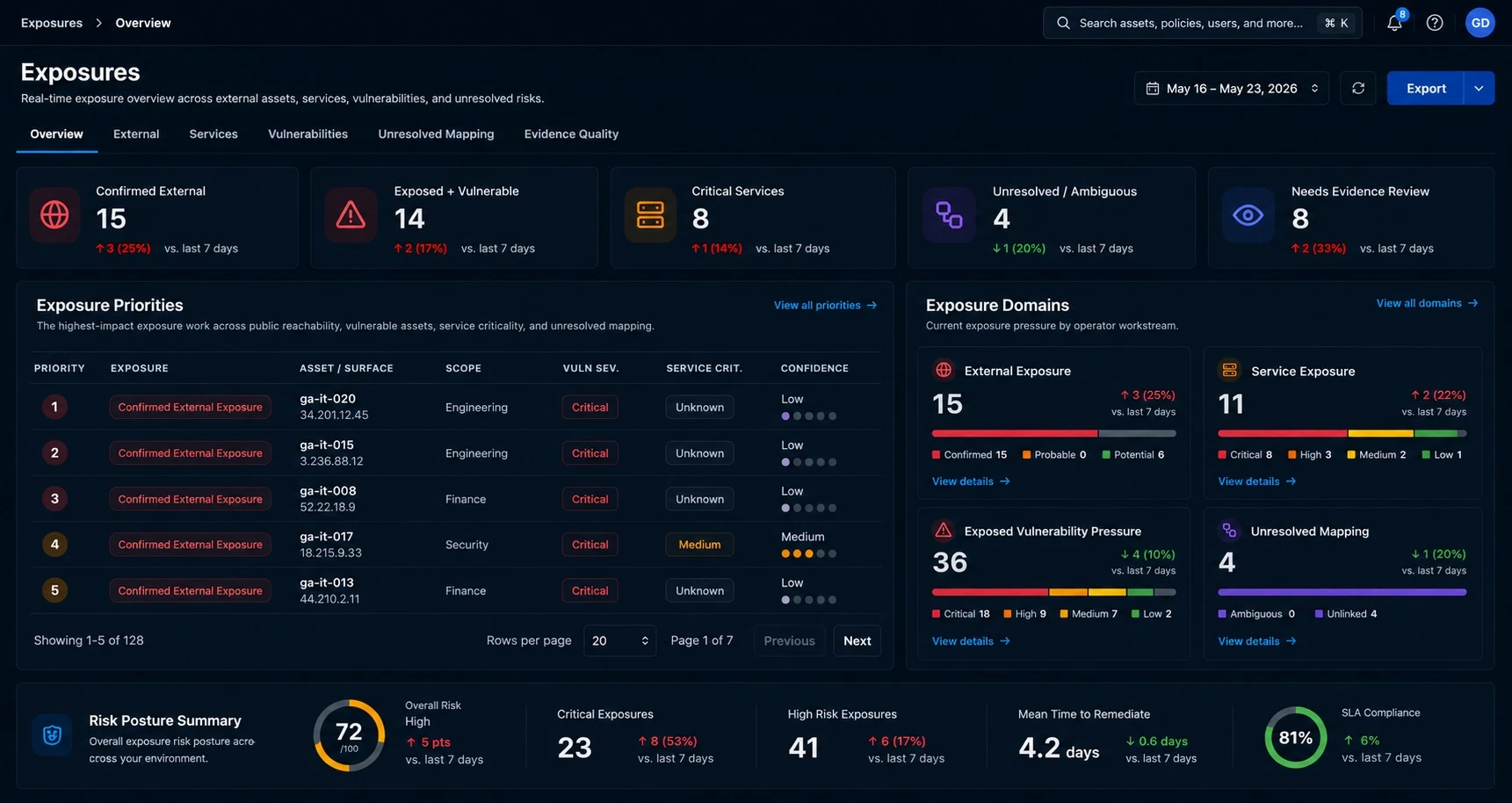
From visibility to investigation
Exposure management starts with understanding which systems and services may be reachable, what they connect to, and why they matter. GreyAware combines supported source observations with asset and vulnerability context, keeping the evidence behind each assessment available for review.
Bring public endpoint, service, and network-path observations from supported sources into a shared exposure view.
Review the reachability assessment, asset linkage, and observation freshness. Investigate incomplete paths and uncertain matches.
Consider service criticality, environment sensitivity, and available vulnerability evidence alongside the quality of the underlying data.
An investigation in practice
A cloud workload has a public endpoint and an inbound rule that allows remote administration from any address. Review the service observation and the full network path before deciding how to respond.
Illustrative workflow and sample data.
A permissive rule is useful exposure evidence. It does not, by itself, prove that the service is reachable or that a system has been compromised.
Confirm that the public endpoint is linked to the correct workload and that the observation is current.
Review listener evidence and the available network policy context. Resolve missing hops or conflicting observations.
Use service importance and available vulnerability context to prioritize an owner review through your approved change process.
Evidence for the next decision
A priority is more useful when your team can explain it. GreyAware retains the factors behind the assessment so security and infrastructure teams can work from the same context.
Explore the platformDistinguish confirmed, probable, internal-only, and unknown exposure assessments based on available evidence. Review the service and network-path observations behind the result.
Bring available vulnerability findings and environment sensitivity into the exposure review. Missing vulnerability data remains a coverage question, not evidence of a clean system.
Identify unresolved or ambiguous asset links and aging observations. Resolve those uncertainties before treating a surface as confidently attributed and current.
Plan your evaluation
Start with your tools, the evidence you need, and the decisions your team makes.
Read our privacy policyThe workflow uses exposure-capable integrations and the endpoint, service, and network-policy observations they provide. Source coverage and permissions determine what is visible. Bring your cloud and security tools to the demo so we can confirm the supported evidence for your environment.
No. A public endpoint is one part of the path. Listener state, inbound rules, translation, and other network controls can affect reachability. GreyAware distinguishes exposure assessments according to the evidence it has, and incomplete path context still needs review.
Prioritization considers the observed exposure, service risk, available vulnerability evidence, environment sensitivity, asset-link confidence, and freshness. The result includes supporting factors and a reason summary so your team can inspect the basis for the priority.
Unresolved, ambiguous, and conflicting mappings remain visible as investigation work. An endpoint should not be treated as confidently owned by a device until the available identifiers and source context support that connection.
This workflow brings supported exposure and vulnerability observations together for investigation and prioritization. It does not establish exploitability through a penetration test. Keep the source collection, testing, and validation appropriate to your environment.
Freshness depends on each source and its collection cadence. Review observation timing before acting. This workflow supports investigation; network changes, patching, and other remediation should follow your approved operational process, with fresh evidence used to check the result.
See GreyAware in context
Choose a service, a cloud workload, or an unresolved public endpoint. We’ll walk through the supported evidence and the context your team can use to prioritize a review.
Allow Google Analytics to use cookies to help us understand visits and improve the site. Your choice won’t affect contact requests. Privacy details